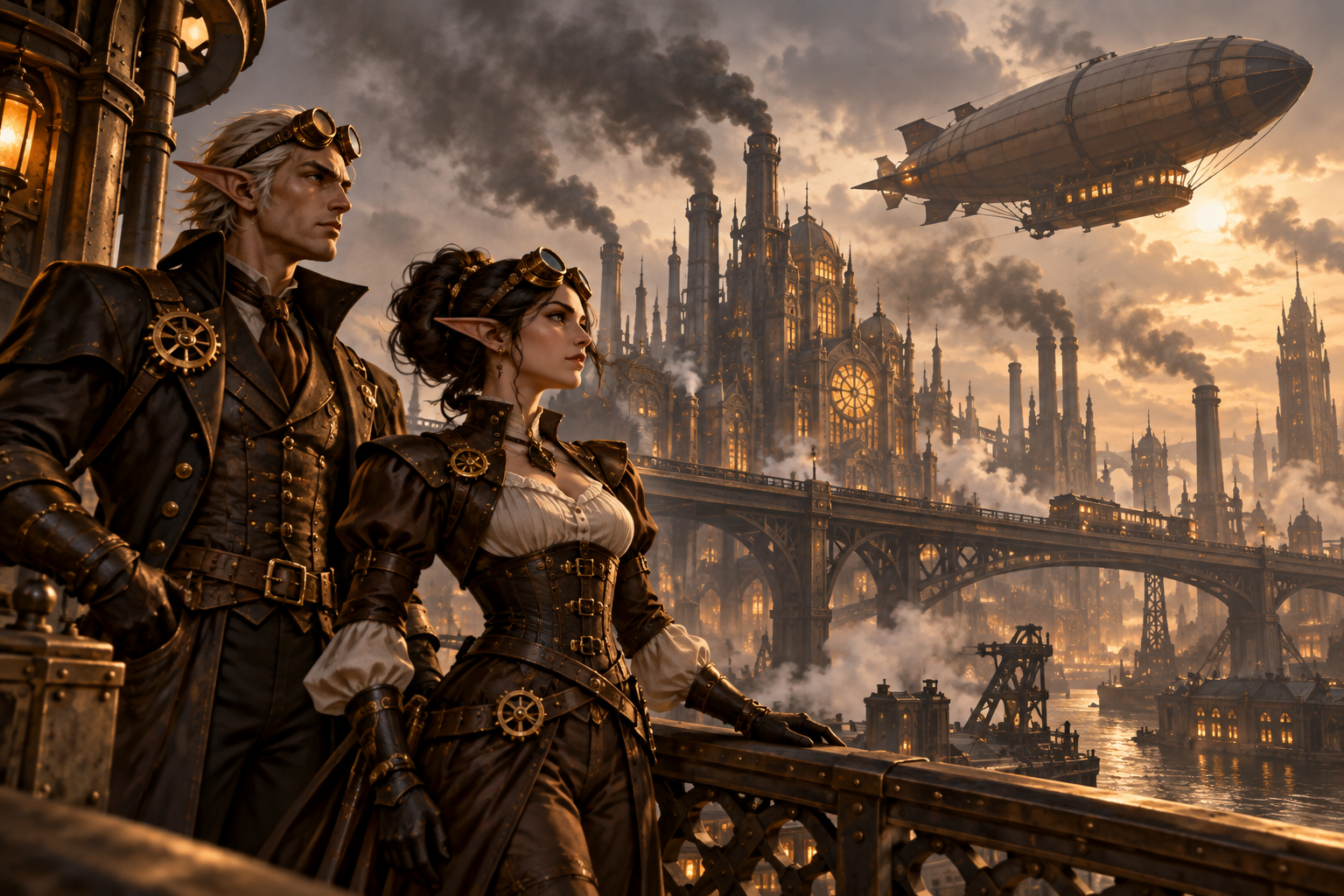
Elven refugees and settlers establish Metropolis in the mineral-rich but barren Midland Wastes. With little fertile soil or timber, survival depends upon engineering, irrigation, mining, and trade. The first General Assembly is created, bringing artisans, scholars, merchants, and landowners together under a loosely representative government.
Engineers and natural philosophers establish the Metropolitan Academy of Practical Sciences. Its members gradually become known as the Thinkers, arguing that careful study and planning offer better solutions than political ambition or military force. Their irrigation pumps and agricultural experiments allow the city's population to grow dramatically.
Inventor Tiberiel Voss develops the first practical steam engine. Within decades, steam pumps drain mines previously considered inaccessible, while mechanical mills transform Metropolitan manufacturing. The invention begins an era of extraordinary prosperity—and an equally extraordinary appetite for coal, iron, and water.
Industrialists, military officers, merchants, and ambitious politicians organize themselves into the Society of Doers, more frequently known simply as the Doers. Their maxim is simple: problems are solved through direct action. They accuse the Thinkers of allowing endless deliberation to prevent necessary reforms.
Following years of governmental paralysis, Doer politicians force through constitutional reforms that replace much of the old Assembly with a smaller Executive Council. The Thinkers retain representation, but executive power increasingly rests with officials drawn from industry and commerce. Metropolitan politics begin shifting decisively toward the Doers.
The richest mines surrounding Metropolis begin to run dry. Iron prices triple within fifteen years, threatening factories and rail construction. The Thinkers advocate recycling programs and more efficient manufacturing; the Doers instead negotiate—and occasionally coerce—neighboring territories Transylvania and Vulcania into granting Metropolitan companies mining rights.
Thinker engineer Ivan Cogwright unveils a steam-powered humanoid machine capable of performing simple instructions. Early automatons possess no independent intelligence and are deployed in mines considered too dangerous for elves. Metropolitan newspapers celebrate the possibility of a future in which machines perform all unpleasant labor.
Disputes over coal deposits lead to war between Metropolis and several neighboring states. Superior artillery, railroads, and industrial production give Metropolis a decisive advantage. The defeated territories are officially designated Metropolitan Protectorates, although their mines and industries are placed under direct Metropolitan control.
Metropolis reaches the height of its industrial expansion. Enormous factories dominate the city, locomotives connect its protectorates, and steam-powered machines perform much of its manual labor. Yet the Midland Wastes are becoming increasingly barren. Forests have virtually disappeared, rivers are heavily polluted, and easily accessible coal seams are disappearing.
Thinker mathematicians construct the first programmable mechanical computer, an enormous machine of brass gears, punched plates, and rotating cylinders. Originally designed to perform scientific calculations, it is soon adopted by the government to coordinate railways, factories, census records, and military logistics.
The Executive Council orders the first comprehensive survey of Metropolitan resources. Its findings are alarming: continued population and industrial growth will eventually exceed domestic supplies of timber, fertile land, coal, and rare earth metals. Thinkers recommend conservation and slower growth. Doer politicians dismiss this as an acceptance of decline.
After a severe economic depression and months of political unrest, the Doers win overwhelming control of the Executive Council. They reorganize the protectorates into formal imperial provinces and establish the office of First Executor, concentrating authority in a single executive office. Metropolis increasingly begins referring to itself as the Empire.
Advances in mechanical computation produce machines capable of learning from previous instructions and modifying their own behavior. These machines remain enormous and expensive, but their designs are incorporated into increasingly sophisticated automatons. Thinker philosophers begin debating an uncomfortable question: at what point does a machine cease to be a machine?
Metropolitan explorers map the distant forest isle of Avalon. Their reports describe immense forests, fertile soil, navigable rivers, and mineral deposits beneath largely undeveloped land. To the Doers, Avalon appears to be a paradise and a treasure trove of natural wealth. Thinkers warn that the island is already inhabited by elves, fairies, nymphs, goblins, and countless animal and insect species, but their complaints are largely ignored by public sentiment.
The government authorizes construction of a railway toward Avalon and grants industrial companies concessions along the forest's eastern frontier. Officially, the project exists to encourage commerce. In practice, Metropolitan lumber companies begin cutting Avalonian timber while surveyors identify locations for mines and farms.
Metropolitan soldiers searching for saboteurs encounter a gathering of nymphs near a river crossing. Confusion escalates into violence, leaving dozens of nymphs dead. The Doer government describes the incident as a response to hostile resistance. Thinker investigators dispute that account and demand an independent inquiry. Their report is first suppressed and later dismissed as conspiracy theory.
Metropolitan forces attempt to seize the Avalonian elven settlement of Rivenhold, expecting its inhabitants to accept annexation rather than fight fellow elves. Instead, Avalonian forces—including Metropolitan expatriates—defeat them. The loss transforms what had been presented as economic development into an increasingly obvious colonial war.
Several advanced automatons independently refuse orders during a factory accident, choosing instead to rescue trapped workers. When engineers investigate, they discover that the machines possess persistent identities, preferences, memories, and apparent self-awareness. The machines begin calling themselves the Robota and formally petition the Executive Council for recognition as legal persons.
The petition is rejected.
After the Avalonian settlement of Godwyn's Rest refuses independent contractor bids, Metropolitan artillery destroys it. The Doer-controlled government argues that the settlement had become a base for insurgents. The Thinkers condemn the attack, and thousands march through Metropolis demanding an end to the war. Several robots refuse orders to manufacture replacement artillery shells and are themselves replaced.
A major Metropolitan offensive penetrates deep into Avalon but is defeated when fairies, elves, nymphs, and goblins unexpectedly fight together. The enormous cost of the campaign shocks Metropolitan society. The Doers respond by demanding greater mobilization; the Thinkers conclude that conventional political opposition is no longer sufficient.
Thinker scientists develop practical solar panels capable of powering machinery without coal. The invention could dramatically reduce Metropolis's dependence on imported fuel and weaken the economic argument for continued expansion.
Doer industrial interests, heavily invested in mines and colonial concessions, prevent widespread adoption. Several Thinkers secretly begin distributing the designs to independent workshops.
Thinker leaders secretly meet representatives of the robot movement. Their motives differ: the Thinkers want to end the exploitation of Avalon and reform Metropolitan government, while the robots demand citizenship and an end to compulsory machine labor. They nevertheless agree to cooperate.
Thinkers begin leaking military plans and falsifying production forecasts. Robots introduce subtle errors into weapons shipments, redirect supplies, and deliberately slow military factories.
Metropolitan politics effectively divide into three camps. The Doers control the government, military, and most heavy industry. The Thinkers dominate universities, scientific institutions, and parts of the civil service. The Robota, though still legally property, increasingly control the automated infrastructure upon which both groups depend.
For the first time in centuries, the Doers find themselves struggling to maintain absolute authority over Metropolis.
The Doer government launches its greatest gamble: a massive offensive intended to divide Avalon with a fortified railway and permanently secure its forests, farmland, and mineral deposits. Against all odds, Avalon's formerly hostile peoples meet the invasion as a unified army and repel the assault.
Meanwhile, Metropolis descends into squabbling and infighting as major cracks appear in the Doer power structure. Thinker officials delay troop movements. Railway schedules mysteriously change. Robots misroute ammunition, disable artillery loaders, and allow resistance fighters to escape surveillance. Solar generators appear in neighborhoods where the government had prohibited their installation. The Metropolitan army remains immensely powerful, and the empire still occupies large portions of eastern Avalon. But the assumption underlying centuries of Doer politics—that every shortage can be solved by taking something from somewhere else—is beginning to collapse.